Beyond the Hearing Aid — Understanding Assistive Listening Devices (ALDs)
When people think about navigating hearing loss, the first and only thing that usually comes to mind is hearing aids.
While hearing aids and cochlear implants are foundational, they aren't magic wands. They amplify sound, but in noisy conference rooms, open-plan offices, or large public spaces, background noise and distance can still make communication an uphill battle.
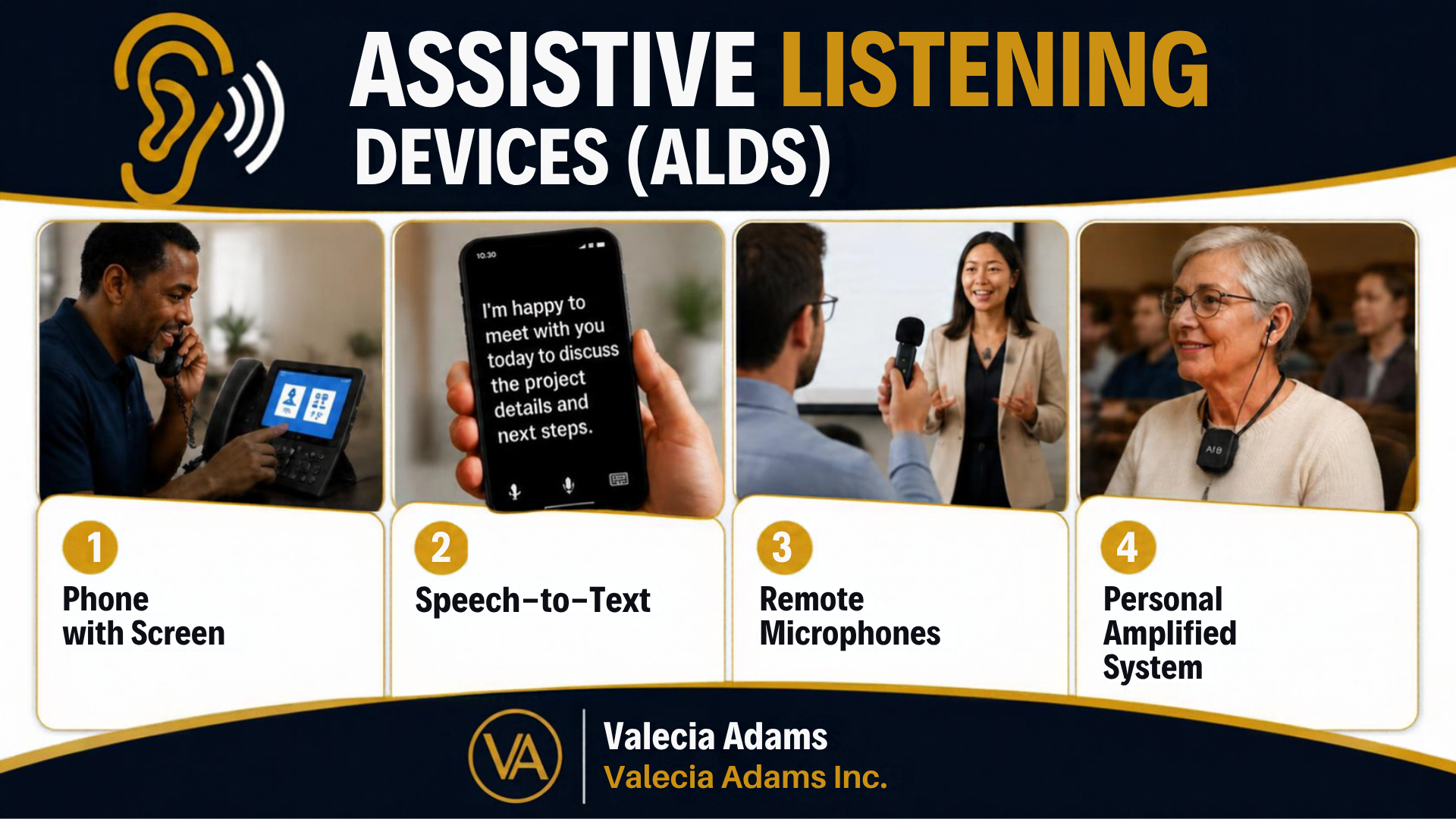
An image showing four accessibility tools: a phone with a screen, speech-to-text on a mobile phone, remote microphones, and a personal amplified system.
That is where Assistive Listening Devices (ALDs) come in.
Understanding what these tools are, how they work, and where they fit into daily life gives you—or your team—the autonomy to navigate spaces with confidence. Here are a few core tools that bridge the gap:
Hearing Loops & Telecoils (T-Coil): A copper wire broadcasts pure speech directly into a hearing aid magnetically, cutting out background noise entirely. You'll often see these in theaters, lecture halls, and service counters marked with the blue-and-white "T" symbol.
Tabletop & Remote Wireless Microphones: Portable puck mics placed on a conference table or clipped to a speaker's collar, beaming clean audio straight to hearing devices while dampening 360-degree background noise.
Infrared (IR) Systems: Utilizing invisible light waves that cannot pass through walls, these systems offer total privacy and security—making them the gold standard for courtrooms, executive boardrooms, and medical consultations.
Captioned Telephones & Real-Time Displays: Essential tools for office desks and call centers that amplify volume while displaying word-for-word live text captions.
The Takeaway

A smiling man hands a microphone to a smiling woman as she clips it to her collar.
Familiarity with assistive technology isn’t just for individuals experiencing hearing loss. When colleagues, leaders, and event organizers understand these options, they become true allies in fostering seamless communication equity.
Technology is always evolving, but the goal remains the same: stopping the exhaustion of straining in silence and stepping into clear, confident connection.
"Imagine a world where our tools don't just amplify sound, but actively support our cognitive energy." That is what technology can do for hearing in our near future.
Read more: Source: Columbia University Zuckerman Institute)